

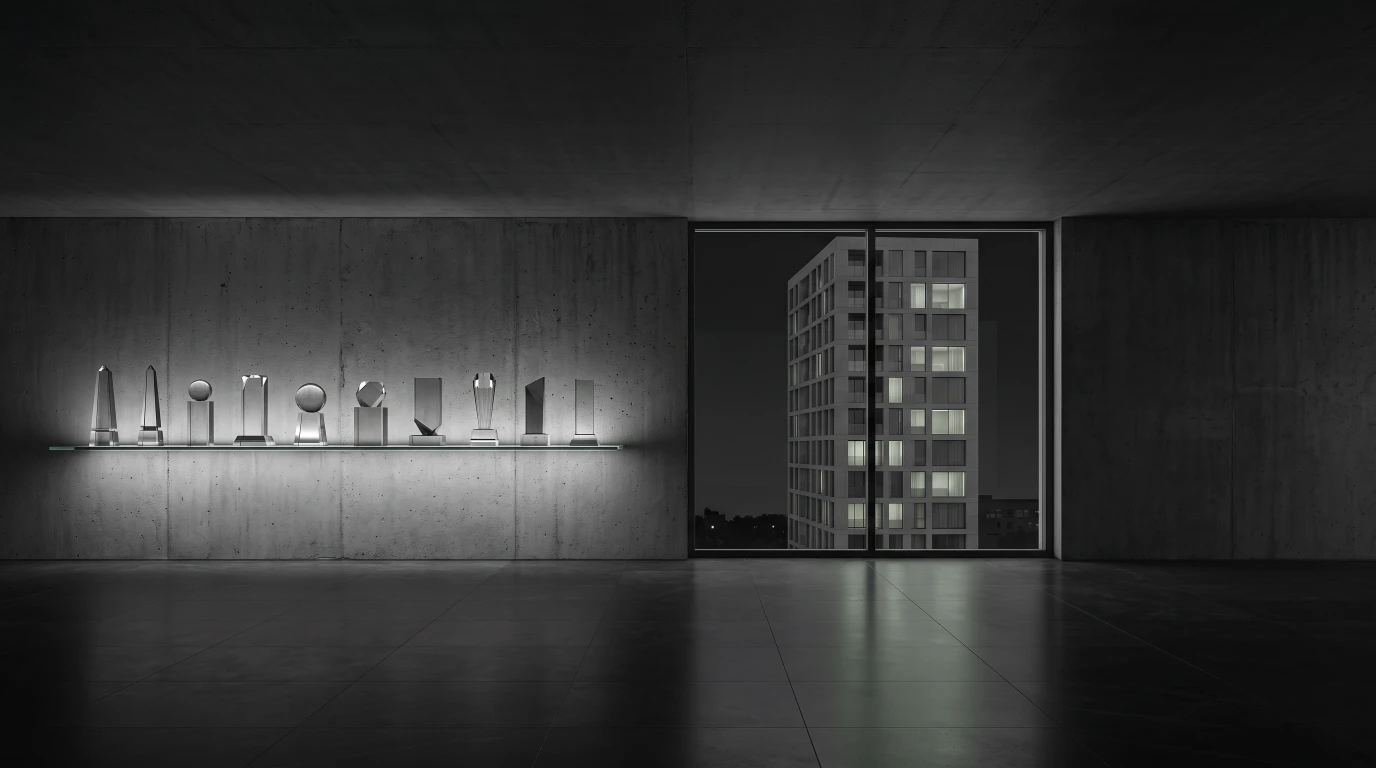
The sales gallery had a glass shelf behind the reception desk, lit from below, holding eleven trophies. I counted them while we waited for the sales manager. Two of them were for the same project in the same year, from two different publications, and one of the brass plaques had been turned to face the wall, presumably by whoever dusted the shelf that morning.
Nobody in the gallery looked at it. A couple in their forties came in while we were there, walked straight past the shelf, and asked the sales manager the only question they had driven forty minutes to ask. Their cousin had bought in the developer's previous project, three kilometres away. Had that building been handed over yet, and was the lift working?
The sales manager did not know. The shelf could not tell them either.
The Shelf Is for the Developer
Most real estate awards are bought, in the polite sense. There is usually an entry fee and a gala dinner with a table to fill, and the categories are written broadly enough that most entrants go home with something. None of that makes them dishonest. It does make them close to useless as evidence, and buyers have worked this out.
A buyer cannot tell the difference between a jury award and a sponsored one, so they discount both to zero. What they can tell the difference between is a developer whose last building was handed over on time and one whose wasn't, because somebody they know lives in it. Real estate developer reputation is assembled almost entirely from that second kind of evidence, the kind that walks around in WhatsApp groups and family dinners, and almost none of it is produced by the marketing department.
So the shelf exists for an audience of one. It reassures the developer that the brand is in good shape. The buyer in the gallery is reading something else entirely, and usually reading it from the building next door.
Buyers have stopped believing what developers say about themselves. They still believe what the last building says.
This matters more than it used to. Mumbai real estate developers now launch into a market where every competitor has a glossy film and a few real estate awards to mention in the press release. When every launch looks equally confident, confidence stops being a signal. Developer credibility moves to the one thing a competitor cannot copy at short notice: a record of finished buildings and the people living in them.
Reputation Is Built at Handover
If reputation is built anywhere, it is built in the eighteen months around possession, which is exactly when most developers stop communicating.
The marketing budget is spent on the launch. The sales team has moved on to the next project. The buyer, who has paid nearly everything by now, is left dealing with the CRM team and a site office that answers questions in the order it feels like. The handover experience becomes a run of delayed emails and a snag list nobody seems to own, and it is in exactly this window that a buyer decides what to tell their cousin.
The possession letter is a good example of how little attention this gets. It is the document a buyer has waited three or four years for, and it usually arrives as a scanned PDF of a legal template, with a demand for the final instalment on the same page as the congratulations. A well-made possession letter, clear about dates and next steps and written by someone who remembers that this is the happiest document the buyer will ever receive from you, costs almost nothing. It is the start of the testimonial you will want from that buyer in two years.
Developers who get the handover experience right tend to do a few unglamorous things consistently. They tell buyers about delays before the buyer finds out from the site, and they make sure the day of possession feels like an occasion rather than an appointment. One developer I worked with had the site team photograph each family receiving their keys at the door of their own flat, and posted the print to them a week later. Years afterwards, those buyers still mention the photograph.
That is the raw material of real estate developer reputation. It is also, almost always, left on the table.
Pick your last completed project and call five buyers who took possession there. Ask one question: would you buy from us again? Write down the exact words they use. That is your reputation, in the only form a future buyer will ever hear it.
Put the Proof Where Buyers Look
Having the evidence is half the job of building a real estate developer reputation. Most developers bury it.
Customer testimonials for real estate are usually filmed at launch events, scripted, and lit like a commercial, which is why nobody believes them either. The ones that work are recorded after possession, in the buyer's own living room, in their own words, including the bit where the lift took two months longer than promised. Good customer testimonials for real estate are closer to journalism than to advertising. A testimonial with one honest complaint in it is believed more than ten without, because it sounds like a person rather than a brochure.
The builder track record deserves the same treatment. In most sales galleries it is a slide near the end of the presentation, listing project names and square footage. A buyer wants something much simpler: the date you promised for each finished building, next to the date you delivered it, and a few families who live there and would take a call. A builder track record presented that plainly is rarer than any award, and far more persuasive.
The real estate corporate brochure is where all of this should live, and where it is most often missing. The typical corporate brochure opens with the founder's vision, moves through the company's values, and gets to the delivered projects on page fourteen, as photographs of facades with no people in them. Turn it around. Open with the buildings that are finished and lived in, with the handover dates and the residents, and let the vision follow the evidence instead of standing in for it.
This is the work a real estate corporate branding agency should be pushing for in every real estate corporate brochure it touches, and often isn't, because a trophy is easier to photograph than a family at a front door. It is also the least expensive thing on this list. The evidence already exists, in the CRM and in the memories of buyers who would happily say something kind if anyone asked them.
Developer credibility will increasingly be decided by which developers can show their finished work and which can only describe it. Mumbai real estate developers who start collecting that proof now, one handover at a time, will walk into their next launch with a real estate developer reputation that no competitor can buy from an awards committee. The rest can keep the shelf lit.